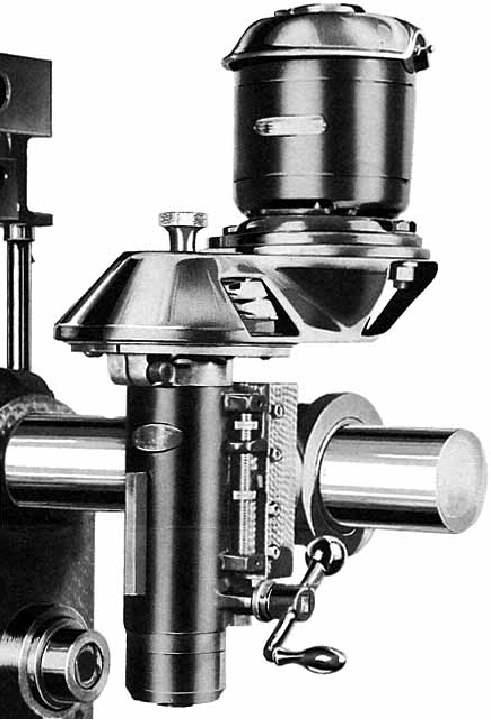
Moog's AC7257 slip ring has a through-bore model that provides power and signal communications and is designed for applications like packaging systems, machine tools. 2236 Rutherford Road, Ste. 119, Carlsbad, California 92008, United States.
Left: Moog synthesizers in the early 1970s right: Historical Moog synthesizers Moog synthesizer (pronounced; often to, though preferred the former ) may refer to any number of designed by Robert Moog or manufactured by, and is commonly used as a generic term for older-generation analog music synthesizers. The Moog company pioneered the commercial manufacture of modular voltage-controlled systems in the mid 1960s. The technological development that led to the creation of the Moog synthesizer was the invention of the, which enabled researchers like Moog to build electronic music systems that were considerably smaller, cheaper and far more reliable than earlier -based systems.
The Moog synthesizer gained wider attention in the music industry after it was demonstrated at the in 1967. The commercial breakthrough of a Moog recording was made by in the 1968 record, which became one of the highest-selling recordings of its era. The success of Switched-On Bach sparked a slew of other synthesizer records in the late 1960s to mid-1970s. Later Moog modular systems featured various improvements, such as a scaled-down, simplified, self-contained musical instrument designed for use in live performance.
Contents • • • • • • • • • • • Early history [ ] The Moog company pioneered the commercial manufacture of modular voltage-controlled systems. Capcom Classics Collection 2 Xbox Iso Torrent there. Company founder Robert Arthur Moog had begun manufacturing and selling vacuum-tube in kit form while he was a student in the early 1950s and marketed his first transistorized theremin kits in 1961.
Moog became interested in the design and construction of complex electronic music systems in the mid-1960s while completing a Ph.D. In Engineering Physics.
The burgeoning interest in his designs enabled him to establish a small company (R. Moog Co., which became Moog Music and later, Moog Electronics) to manufacture and market the new devices. Pioneering electronic music experimenters like,, Christopher R. Morgan, and had built sound-generating devices and systems of varying complexity, and several large electronic synthesizers (e.g. The ) had been built before the advent of the Moog, but these were essentially unique, custom-built devices or systems.
Most Viewed Articles
- Download Nero 11 Full Crack Mfrmls
- Vicinity Map Creator Autocad Free
- Installazione Connect Nav Alfa 147 Facelift
- Rapidshare London Calling Salon
- Autocad Mac Free Download
- Download Free Email Outlook Pdf Student Web Uoc
- The Bourne Identity Pdf Ebook Books
- Applied Calculus 9th Edition Tan Pdf Free
- Canon Vixia Hr300 Manual Treadmill
- Otc Genisys 3 0 Manual Dexterity
- Intellectual Disabilities Across The Lifespan Ninth Edition Encyclopedia